How Operators Can Turn AI Tokens Into a Revenue Business

*Blog by Bejoy Pankajakshan, EVP, Chief Technology and Strategy Officer, Mavenir
The infrastructure and commercial case for operator AI token monetization, and the Mavenir platform enabling it
Token-based consumption is emerging as the next billing unit for communications services. As AI becomes embedded in subscriber experiences, enterprise workflows and network operations, the question for operators is not whether tokens will matter commercially, but whether they have the infrastructure to control, meter and monetize them. The commercial case is already proven: operators in markets including China have begun packaging AI token quotas as network utility plans alongside voice and data. The infrastructure challenge, however, is more complex than it first appears.
Related Press Release: Mavenir Collaborates With Red Hat to Launch Integrated AI Platform to Turn Operators Into AI Service Providers
For an operator launching an AI token service today, tokens generated on third-party cloud servers are counted by the cloud vendor, not the operator. The operator has no billing-grade token meter, no plan enforcement mechanism, and no way to prevent runaway spend. Selling a token plan without these capabilities is structurally equivalent to selling a data plan with no network-level usage counter. Mavenir has built the infrastructure layer that closes this gap.
Three Ways Operators Can Make Money on AI
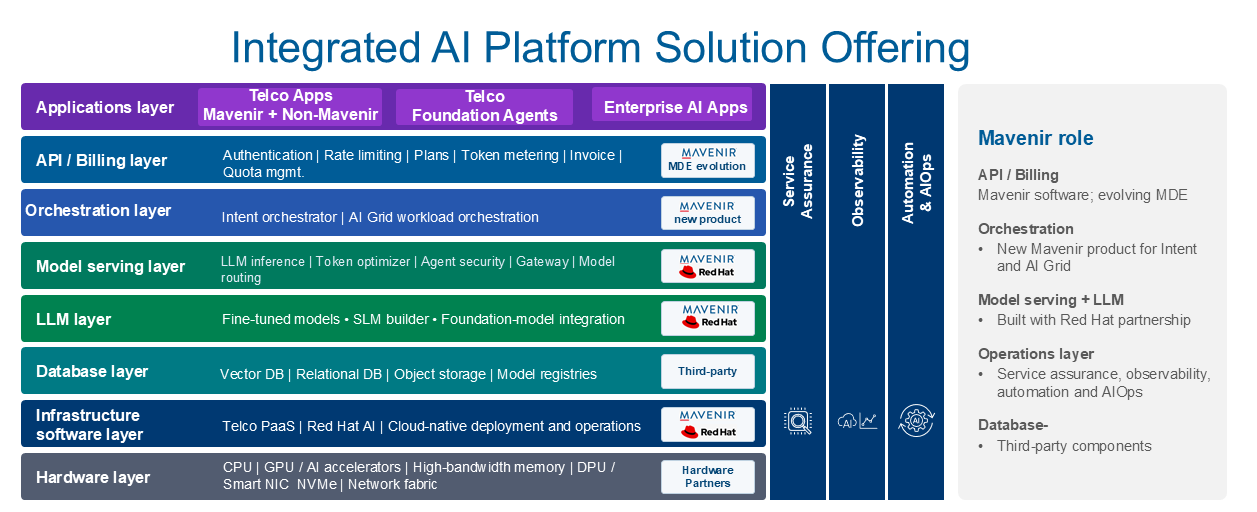
The Mavenir Integrated AI Platform is built around three distinct commercial models, each with different economics, target customers and operational requirements.
1. Subscriber AI Service Plans: The operator packages AI tokens as a bundled connectivity-plus-AI product billed directly to the subscriber. Plans follow the familiar tiered structure: Basic (10M tokens/month), Standard (50M tokens), Business Unlimited. The operator controls pricing by setting service tiers and owns the commercial relationship end-to-end. Billing is fully integrated: tokens are metered and charged through the operator’s existing BSS using the same mediation infrastructure as today’s data plans.
2. Enterprise AI-as-a-Service: The operator offers metered access to AI models, compute and developer tooling to enterprise customers alongside existing connectivity contracts. Enterprises receive a governed, sovereign AI environment where their data remains on the operator’s infrastructure. The operator bills on consumption and packages platform SLAs for the infrastructure layer, providing a commercially structured alternative to open-ended cloud AI procurement.
3. AI Grid Infrastructure Services: The operator monetizes its existing physical infrastructure, including central offices, edge compute facilities and distributed GPU capacity, as the AI inference fabric for third-party applications. Rather than selling raw colocation, the operator delivers managed AI infrastructure: compute, model hosting, inference serving and connectivity in a single commercial package. Applications run closer to the subscriber, reducing latency and keeping data in-country.
Why Tokens Work as a Billing Unit at Operator Scale
Token-based billing is intuitive to enterprise buyers and developer teams who already manage token budgets through API pricing. For consumer subscribers, the platform allows operators to present token consumption as concrete outcomes rather than abstract counts: number of AI calls screened, documents summarised or meeting hours transcribed. The metering happens at the token level; the subscriber experience is outcome-based. This mirrors how data plans evolved: bytes are the billing unit, but customers think in hours of streaming or number of apps used.
| Consumer plans | Outcome-based presentation of token consumption removes the abstraction problem. Operators can translate token allowances into recognisable service activities, packaging AI in the same way they package data roaming or international calling. |
| Enterprise plans | Enterprise buyers already manage token budgets via API pricing with cloud vendors. An operator offering governed, on-premises token access with predictable pricing and SIM-anchored identity is a structurally stronger proposition: lower latency, data sovereignty, and a single billing relationship with an existing contracted supplier. |
| Operator economics | By running AI on sovereign on-premises infrastructure rather than paying per-token to cloud providers, the operator sets its own margin. The Mavenir Token Optimizer reduces token consumption before inference calls, lowering the cost per interaction. The SLM Builder eliminates per-token cloud licensing for routine workloads entirely by running fine-tuned operator models on-premises. |
The Mavenir Platform: What Is New
Mavenir is a telecom software vendor with deployments across 300+ operators in 120 countries. Mavenir existing portfolio spans IMS, Packet Core, BSS, network functions and data mediation. Token billing is a mediation problem at its core, and the Mavenir Digital Enablement (MDE) platform already handles charging and billing integration for network services. The Mavenir Integrated AI Platform extends this into AI token metering and introduces capabilities that are not yet available as integrated operator products elsewhere.
- Token metering at BSS depth: MDE counts input and output tokens with billing-grade accuracy, applying the same precision standard used for regulated data usage. The system enforces plan quotas and overage rules, generates per-session and per department itemised records, and connects directly to operator BSS and mediation systems. The billing path for a token plan mirrors the billing path for a data plan: network event, mediation, rating, invoice. No additional billing system is required.
- Model routing as a commercial control: The Model Router directs each inference request to the appropriate model tier: on-premises SLMs for routine low-cost workloads, open-source models for general-purpose tasks, and cloud frontier models only when the task genuinely requires it. This is not purely an infrastructure optimisation; it is a commercial control mechanism. An operator can define that Basic plan subscribers are served by on-premises models while Premium subscribers receive priority routing to frontier models with a latency guarantee. The same infrastructure supports different commercial tiers without manual reconfiguration.
- SIM-anchored identity: The operator’s structural advantage over cloud AI vendors is the subscriber relationship backed by SIM identity.
- Sovereign infrastructure with selective frontier access: The platform is sovereign first by design: models, weights and subscriber data run on operator-controlled infrastructure as the default. For tasks requiring frontier model capability, the Model Router provides policy-governed access to external APIs, and every external model call flows through MDE. The operator retains billing control and cost visibility regardless of which model handles a given request.
- SLM Builder and cost-structure transformation: Fine-tuned Small Language Models built on operator data handle the majority of token workloads at a fraction of the cost of frontier model calls. A customer service SLM trained on operator data costs far less per interaction than routing the same query to a cloud frontier model. The SLM Builder shifts token consumption from variable per-unit cloud cost to fixed on-premises infrastructure cost, giving operators a predictable margin structure at scale.
The Infrastructure Capabilities That Make Token Plans Viable
Several capabilities that operators need to launch token plans commercially are not widely available as integrated products in the market. The Mavenir platform addresses each of them:
| BSS-integrated token metering | Token counting with billing-grade accuracy, connected directly to operator mediation and BSS systems. Plan quotas, overage rules and itemised records are handled within the same charging infrastructure as existing network services. |
| Commercial model routing | Routing policies that map subscriber plan tiers to model tiers. Basic, Standard and Premium plans receive different model access with different latency and quality guarantees, all governed from a single policy layer without infrastructure changes. |
| On-premises AI with frontier connectivity | Sovereign infrastructure as the default deployment model, with policy-governed access to external frontier models when needed. Every model interaction flows through the operator’s token metering layer regardless of where the model runs. |
| Operator-built SLMs | Fine-tuned models built on operator data that handle routine workloads on-premises, eliminating per-token cloud licensing for the majority of traffic and converting variable cloud cost into a predictable infrastructure cost. |